
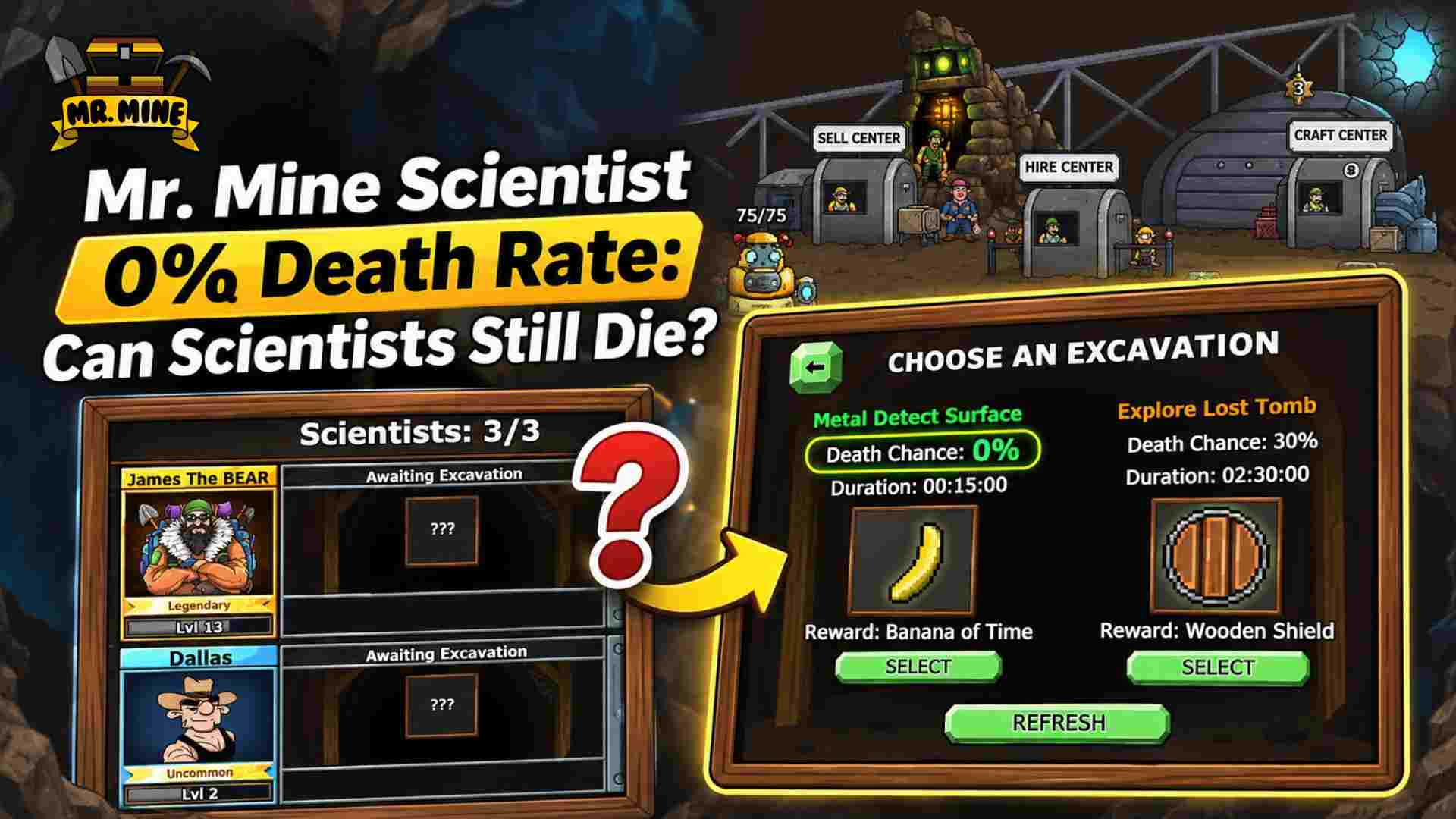
Your Scientist finishes an excavation, but instead of bringing back a reward, they die. The strange part? The mission showed a 0% Death Chance when you started it. The Mr. Mine scientist 0% death rate can be misleading. A displayed 0% may hide a tiny risk if the game rounds the number. That is not the same as a mission with no risk at the start.
The short answer: Yes, players have reported losing Scientists on missions showing 0%. Players and community guides point to rounding and survival bonuses as possible causes. But the latest game code has not been checked here, so we cannot confirm how each death is calculated.
Here is what the numbers mean, which missions are safest, and how to protect your best Scientists.
Can a Scientist Die at 0% Death Chance in Mr. Mine?
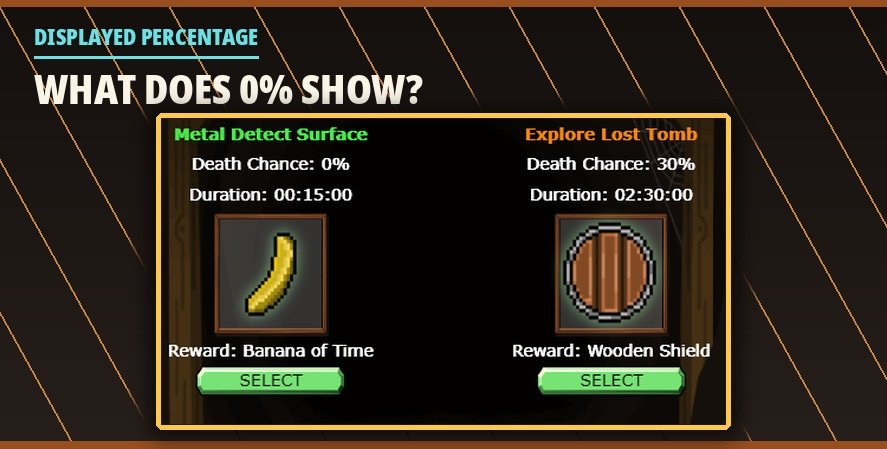
Yes, a displayed 0% does not always prove that the actual risk is zero. Players have reported unexpected deaths on apparently safe excavations, including in a Steam community discussion about Scientist death chance.
The key is the difference between a number shown on the screen and the probability used for the result.
Why a Displayed 0% May Still Carry Risk
A screen that shows whole percentages cannot show every fraction. If it rounds to the nearest whole percent, a risk of 0.4% would appear as 0%.
| Actual death chance (example) | Display if rounded to a whole percent |
|---|---|
| 1% | 1% |
| 0.4% | 0% |
| 0.1% | 0% |
| Exactly 0% | 0% |
These are math examples, not confirmed death rates from current excavations.
A 0.4% chance is small, but it is not zero. If a mission has that underlying risk, a death is possible even when the interface shows 0%.
This is the main explanation discussed in the Mr. Mine Wiki’s Scientist guide. Older player reports also describe it. Still, a single death does not prove exactly how the result was calculated.
A True 0% Is Different
A mission that starts with a true 0% risk stays at zero when bonuses reduce risk. Reducing zero does not create danger.
That distinction matters more than the number alone. To judge the Mr. Mine scientist 0% death rate, check the mission’s difficulty, not just its final displayed Death Chance.
How the Mr. Mine Scientist 0% Death Rate Works
Mission difficulty sets the starting risk. Scientist rarity and relics can lower it. The game also uses extra survival checks, so one simple formula cannot predict every result.
Base Death Chance by Excavation Difficulty
The Mr. Mine Scientist Excavations guide lists these starting death chances:
| Excavation difficulty | Base death chance | What it means |
|---|---|---|
| Easy | 0% | Starts with no listed death risk |
| Medium | 5–10% | Some risk before bonuses |
| Hard | 25–50% | Considerable risk |
| Nightmare | 50–99% | Very high starting risk |
These are base values, not the final risk for every Scientist. A high-rarity Scientist with defensive relics may see a lower number on the mission card.
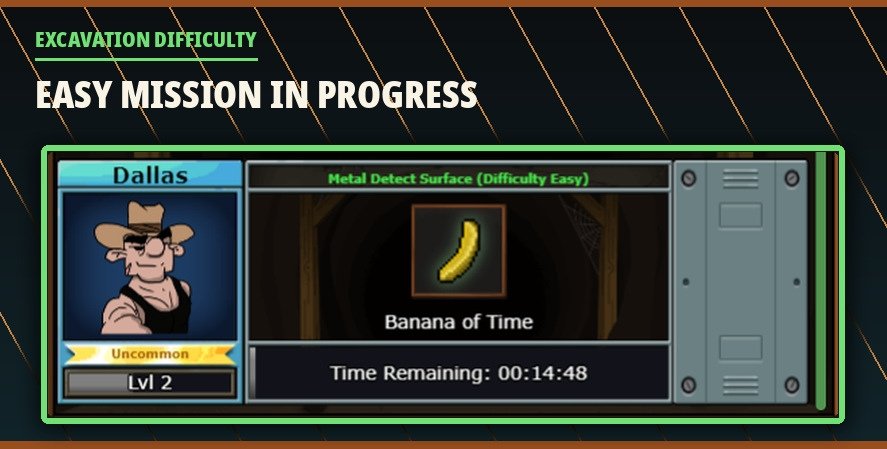
Easy excavations are the important exception. Their documented base chance is exactly 0%. Reducing a true zero cannot create a chance of death.
Medium, Hard, and Nightmare missions begin with nonzero risk. Even if bonuses make one of these missions display 0%, that is not the same as an Easy mission’s zero starting chance.
Scientist Rarity Reduces Risk
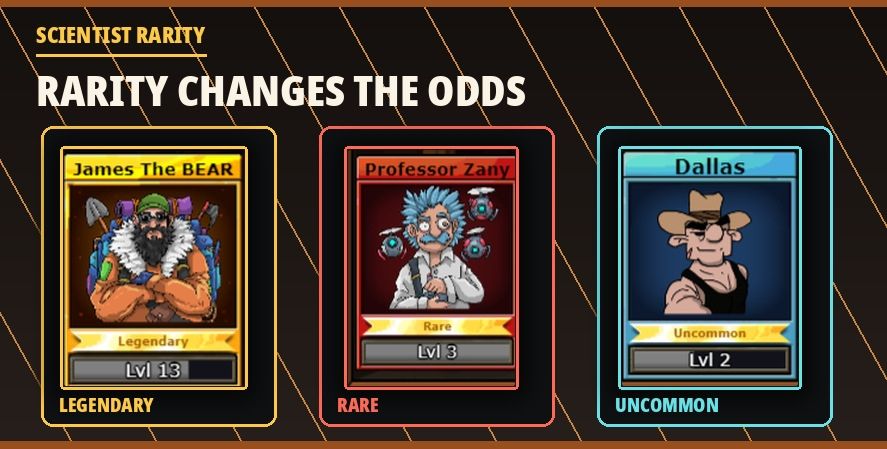
Scientists have four standard rarity tiers. Their documented death-chance reductions are:
| Scientist rarity | Death-chance reduction |
|---|---|
| Common | 0% |
| Uncommon | 10% |
| Rare | 25% |
| Legendary | 55% |
These are proportional reductions, not percentage points taken directly off the mission’s risk.
For example, imagine a mission starts with a 20% chance of death. A Rare Scientist with a 25% reduction would bring that risk to about 15% in a simplified calculation:
20% × 0.75 = 15%
It would not reduce the risk to negative 5%. The Mr. Mine Scientist Rarities guide also notes extra survival rolls for some rarities. That means this example cannot predict every result.
The Book of Success Reduces the Remaining Risk
The Book of Success is a defensive relic that helps Scientists survive excavations. Its versions have these documented bonuses:
- Standard Book of Success: 10%
- Warped Book of Success: 12.5%
- Divine Book of Success: 15%
Their combined reduction is capped at 75%. The cap applies to the Book of Success effect, not to every possible survival bonus in the game.
Suppose a mission has a 20% death chance after other relevant effects. A 10% proportional Book of Success reduction gives a simplified result of:
20% × 0.90 = 18%
Even a full 75% reduction would leave 5% of death risk from that hypothetical 20% starting point. Books make risky excavations safer; they do not automatically make them risk-free.
Which Excavations Are Safe When the Screen Shows 0%?
If survival matters more than the prize, choose an Easy excavation when one is available. Its documented base chance is 0%.
A Medium mission showing 0% is less clear. It starts with 5–10% risk, but rarity and relics can lower it. If the screen rounds the final value, its 0% label may not mean the same thing as Easy.
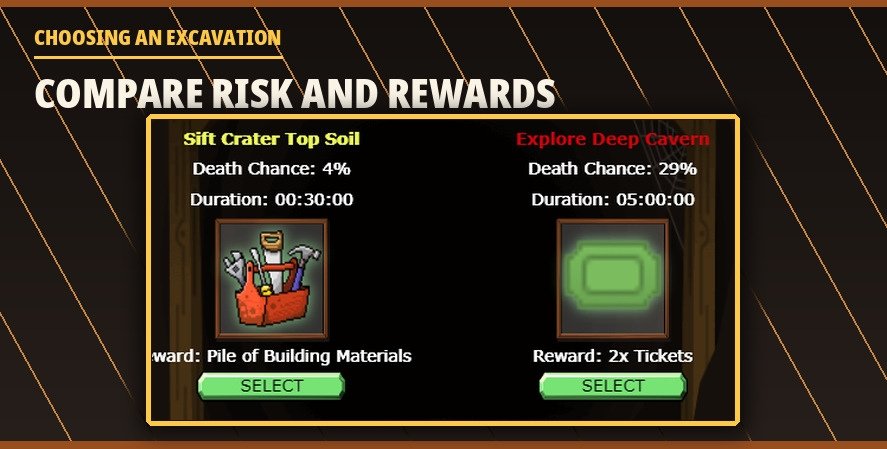
For Hard and Nightmare excavations, treat the displayed number as a guide to risk, not a promise of survival. Ask whether the reward is useful enough to justify losing that Scientist.
A rare relic may be worth pursuing if it helps with a major goal. That risk makes less sense for a reward you already have.
Does Scientist Level or Warped Status Prevent Death?
Level does not directly lower excavation death chance. It affects other parts of Scientist progression, but it does not give the same survival reduction as rarity.
A high-level Common Scientist can face more risk than a lower-level Legendary Scientist on the same mission. Experience adds value. It does not grant immunity.
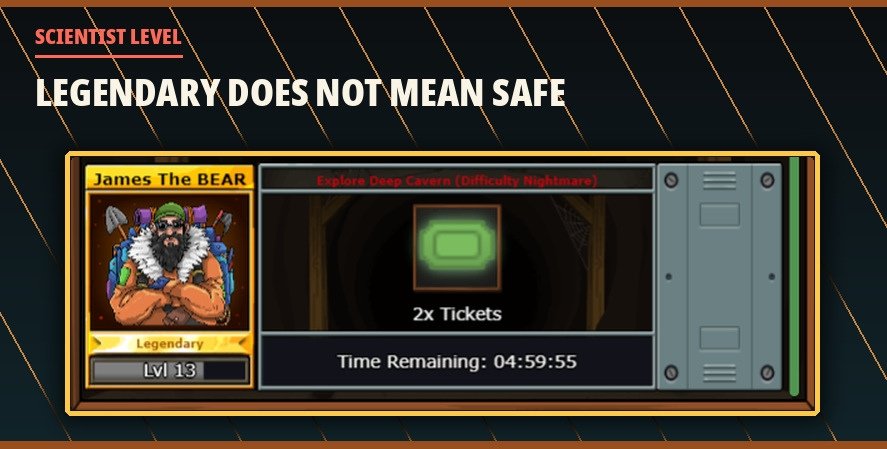
Legendary Scientists have a strong rarity bonus, yet they can still die on dangerous excavations. Warped, Warped+, and Warped++ Scientists offer improved survival-related advantages, but they are not automatically immortal either.
For more details, see the Warped Scientists guide.
If you are researching the Mr. Mine scientist 0% death rate to protect a high-level Legendary or Warped Scientist, prioritize genuine low-risk missions over relying on rarity alone.
How to Lower the Chance of Losing a Scientist
You cannot remove every risk from every mission. But a few habits can help you keep valuable Scientists longer.
1. Check the Difficulty Before the Reward
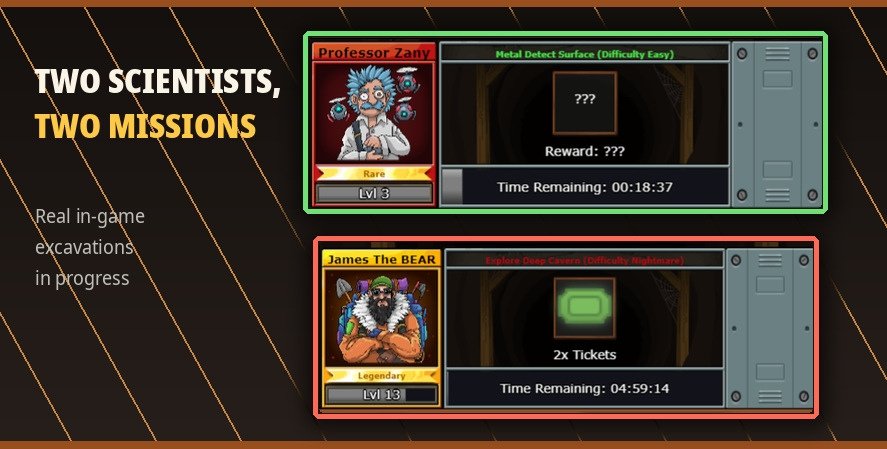
Look at the mission’s Death Chance, difficulty, reward, and duration together. When survival matters most, an Easy mission is usually the safest documented choice. Avoid taking a Nightmare mission just because the reward looks exciting.
2. Match the Scientist to the Risk
Higher-rarity Scientists have better survival bonuses. They can be useful on difficult missions, but they are also harder to replace. Do not risk your best Scientist for a reward that will not help your current progress.
3. Use Book of Success Relics Wisely
Book of Success bonuses reduce excavation death risk. Their effect can stack, but the 75% cap means filling more relic slots will not provide unlimited protection.
Compare the benefit with the other relics you could equip. A defensive setup may be worthwhile while training or protecting a valuable Scientist.
4. Know What Scythe Relics Actually Do
Scythe, Copper Scythe, and Golden Scythe relics work differently from the Book of Success. They improve the chance of automatic resurrection after death, rather than directly removing the initial death chance.
That can help you recover from an unlucky mission. It does not make the mission itself safe, and resurrection is not guaranteed.
5. Think About Repeated Risk
A small risk on one mission may feel harmless. But sending Scientists on risky missions again and again creates more chances for a loss.
Even a small risk can lead to a loss after enough missions. For this reason, repeated low-risk trips are not the same as guaranteed survival.
What Should You Do If a Scientist Dies at a Displayed 0%?
A loss on a displayed 0% mission is frustrating. But it does not prove a bug.
First, note the difficulty of the mission. Was it Easy, or did a higher-difficulty mission display 0% after bonuses?
If the result seems wrong, save the details: Death Chance, rarity, relics, mission difficulty, and game version. A screenshot of the mission card can help others check the issue.
Then decide whether the Scientist is worth bringing back. Mr. Mine provides a Ticket-based resurrection option after a Scientist dies. Compare the cost with their level, rarity, and how hard they would be to replace. Burying a new Common Scientist may be more practical than spending Tickets, while reviving a developed Legendary or Warped Scientist may preserve valuable progress.
Our Should You Revive a Scientist in Mr. Mine? guide explains that choice in more detail.
Frequently Asked Questions
Can a Scientist really die at 0% Death Chance in Mr. Mine?
Yes, players have reported it. A displayed 0% may represent a small remaining probability that is hidden by rounding. That is different from a mission whose actual starting death probability is exactly zero.
Are Easy excavations always safe?
Easy excavations have a documented base death chance of 0%. Bonuses that reduce risk do not add danger to a true zero-risk mission. Check in-game details if the rules change.
Why does a Medium excavation sometimes show 0%?
Medium missions normally start with a 5–10% death chance. Rarity and relic bonuses can reduce it. A display rounded to whole percentages may show 0% even if a very small risk remains.
Do Legendary or Warped Scientists have a 0% chance of dying?
Not on every mission. Their survival advantages help, but higher difficulty can still carry risk. A high rarity or Warped upgrade should not be treated as a guarantee of survival.
Does leveling up a Scientist lower Death Chance?
No. Scientist level does not directly reduce excavation death probability. Rarity and certain relics provide the main risk-reduction bonuses.
Does using a Timelapse increase the risk of death?
The Mr. Mine Scientist and Excavation Missions guide describes the outcome as being decided when an excavation begins. Under that mechanic, a Timelapse reveals the result sooner rather than adding another death roll. This timing detail should be checked if the game changes.
Should I revive a Scientist who died on a 0% mission?
It depends on the Scientist and the Ticket cost. Reviving an experienced Legendary or Warped Scientist may save time. A new Common Scientist may be easier to replace. The displayed chance on the mission does not change that decision.
Final Thoughts: Do Not Judge Safety by the Display Alone
The key to the Mr. Mine scientist 0% death rate is simple: a displayed 0% and a true 0% may differ.
Easy excavations begin with a documented 0% death chance. Other missions may start with risk and appear safer after rarity and relic bonuses. If the interface hides a tiny remaining probability, an unexpected death can still happen.
Protect your best Scientists by checking difficulty, using Book of Success relics where they help, and choosing rewards that justify the risk. If a Scientist does die, compare the resurrection cost with the value of keeping them.
For more ways to manage risk and rewards, read our Scientist Excavations guide.