
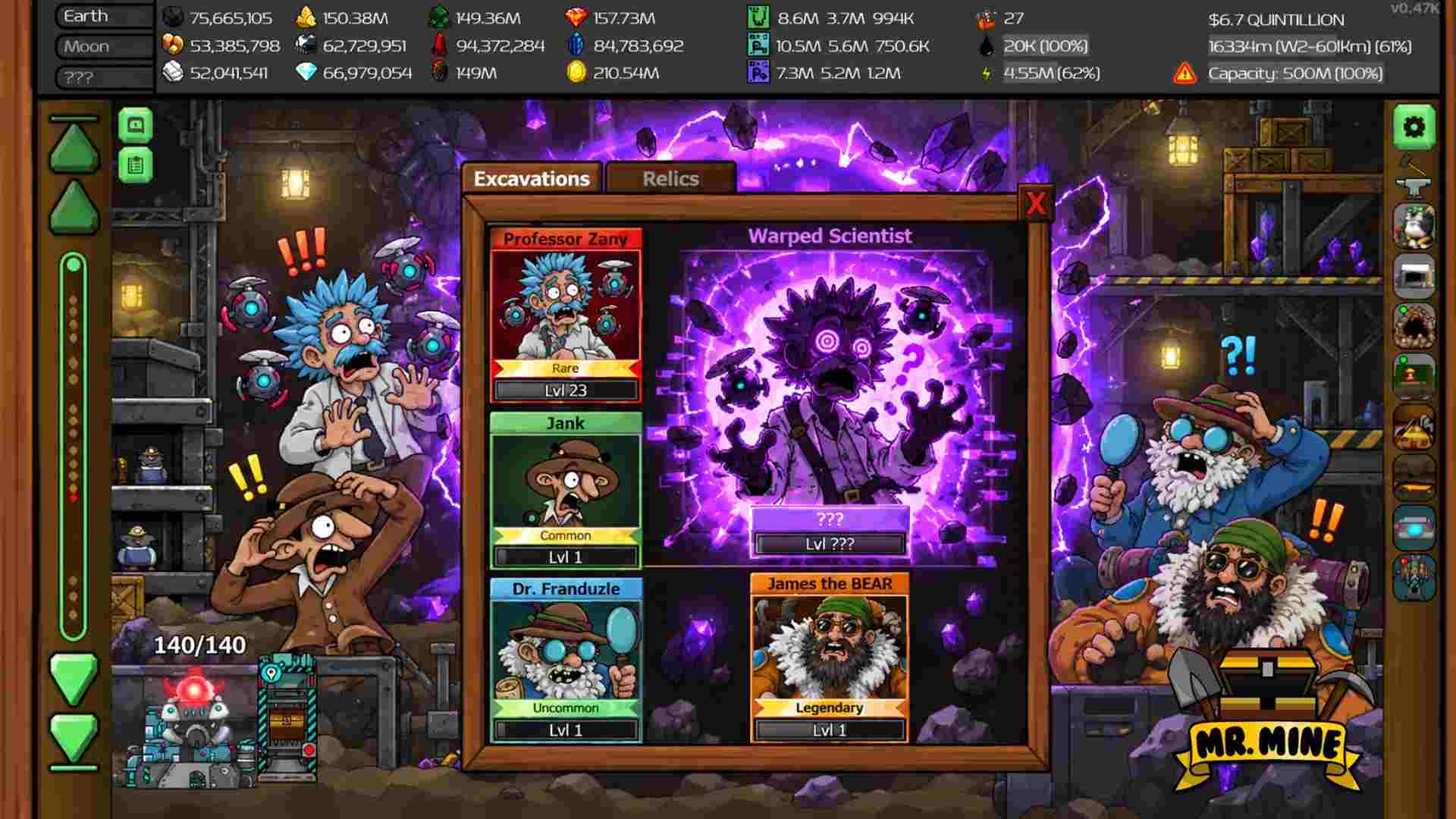
Mr. Mine Scientist Rarities play an important role in the game’s excavation system. Once you unlock Scientists, you can send them on missions for relics, treasure chests, tickets, money, building materials, Super Miner Souls, and other useful rewards.
The catch is simple: some excavations can kill your Scientist.
That makes Mr. Mine Scientist rarities important. A Scientist’s rarity affects how well they handle excavation risk and how quickly they gain experience.
The four standard rarities are:
Common → Uncommon → Rare → Legendary
Later, the Core introduces Warped Scientists, but Warped is better understood as a separate late-game progression system rather than a normal fifth rarity.
This guide explains how Scientist rarity works, how it differs from level, what affects excavation death chance, and when Rare, Legendary, or Warped Scientists become worth protecting.
What Are Scientists in Mr. Mine?
Mr. Mine is a free-to-play idle mining game developed by Playsaurus. It is also available on Steam, where Scientists are listed as one of the game’s progression features.
Scientists and excavations unlock when you reach 50 km in the mineshaft.
Scientists can then be sent on timed excavation missions. These missions can return valuable resources, including relics that improve other parts of your mining operation.
You can obtain Scientists from several sources:
- Treasure chests
- Excavation rewards
- Caves and Scientist scrolls
There are currently 17 standard Scientists, and you can have up to three active Scientists at a time.
For a broader look at how the mineshaft develops as you dig deeper, see the Mr. Mine Mineshaft guide.
How the Scientist Gameplay Loop Works
The basic loop is easy to understand:
Get a Scientist → Choose an excavation → Wait → Collect the reward → Gain XP → Level up → Repeat
The strategy comes from choosing the right missions.
A safe excavation may give a modest reward with little danger. A harder mission can offer something more attractive, but it may put a valuable Scientist at risk.
As your Scientists gain levels and rarity becomes more important, choosing an excavation becomes a question of whether the reward is worth the chance of losing the Scientist.
How Do Mr. Mine Scientist Rarities Work?
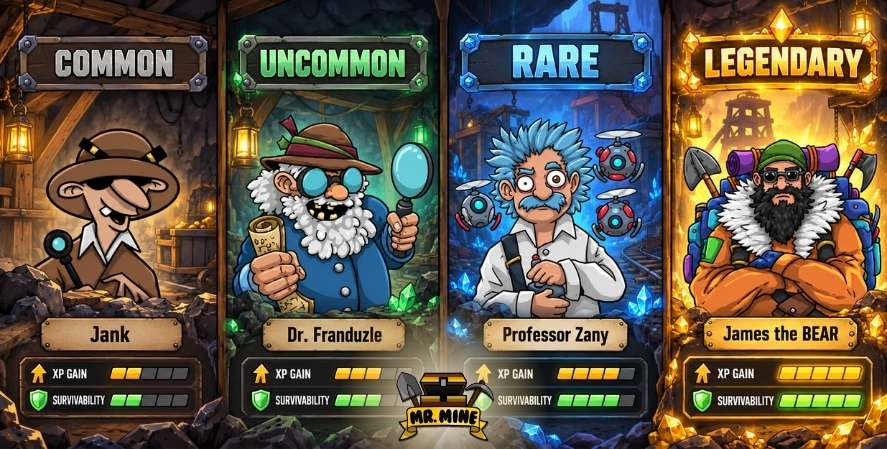
Mr. Mine Scientist Rarities are divided into four standard tiers: Common, Uncommon, Rare, and Legendary.
| Rarity | Failure/Death Chance Reduction | XP Multiplier | Death RNG Rolls |
|---|---|---|---|
| Common | 0% | 1× | 1 |
| Uncommon | 10% | 1.1× | 1 |
| Rare | 25% | 1.25× | 2 |
| Legendary | 55% | 1.55× | 4 |
The main takeaway is:
Higher rarity improves a Scientist’s survival characteristics and XP gain.
However, the percentage in the table should not be read as a simple subtraction from the displayed mission chance.
For example, Legendary’s 55% reduction means its rarity modifier reduces the underlying risk rather than simply turning a 60% mission into a 5% mission.
Higher rarities are also documented as receiving additional death-related RNG rolls. These rolls give Rare and Legendary Scientists another advantage when the game resolves death, although the exact internal roll sequence is not clearly explained in official player-facing documentation.
Common Scientists
Common Scientists are the baseline rarity.
They have:
- No rarity-based failure reduction
- A 1× XP multiplier
- One death RNG roll
Common Scientists include:
Jank, Mrs. Marge, Taylor, Ziggy, The Aussie, Lt. Ramirez, Layla, and Dennis.
A Common Scientist is not automatically useless once you find something rarer. A high-level Common Scientist may still be valuable for everyday excavations while you develop a newer Scientist.
Uncommon Scientists
Uncommon Scientists are the first step above Common.
They receive:
- 10% rarity-based failure reduction
- 1.1× XP
- One death RNG roll
The four Uncommon Scientists are:
Dallas, Ernie, Dr. Gilbert, and Dr. Franduzle.
The difference looks small on low-risk missions, but the faster XP gain becomes more useful across many excavations.
Rare Scientists
Rare Scientists make a larger jump.
They receive:
- 25% rarity-based failure reduction
- 1.25× XP
- Two death RNG rolls
The Rare Scientists are:
Mr. Mustache, Mr. Mustachio, and Professor Zany.
Rare Scientists are especially useful once you regularly see harder missions. Their better survival profile also helps protect the time you invest in leveling them.
Legendary Scientists
The highest standard Scientist rarity.
Legendary Scientists receive:
- 55% rarity-based failure reduction
- 1.55× XP
- Four death RNG rolls
The two Legendary Scientists are:
Dr. Archibald and James The BEAR.
Obtaining a Legendary Scientist also completes the Fancy Pants achievement.
Their strong bonuses make Legendary Scientists excellent long-term choices, but they are not immortal. A dangerous excavation can still kill one.
Does Scientist Rarity Affect Excavations?
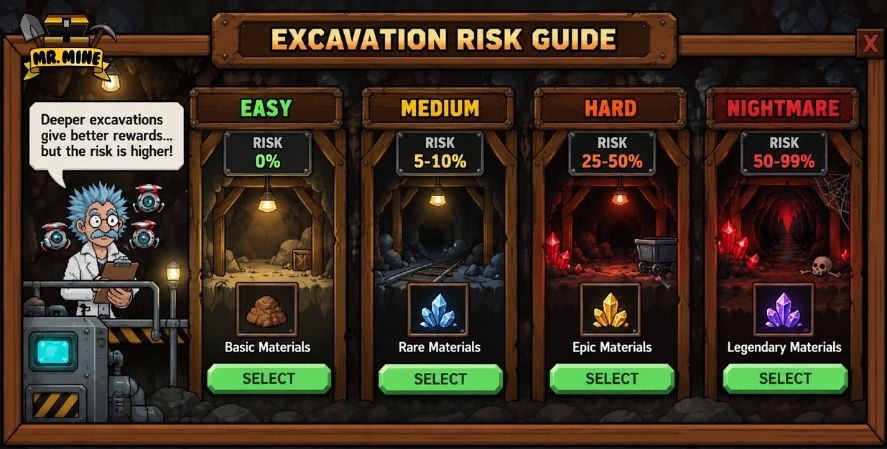
Understanding Mr. Mine Scientist rarities becomes especially important when you start taking excavations with a high chance of death.
Yes, Scientist rarity directly affects excavation risk.
Mr. Mine has four main excavation difficulty groups:
| Difficulty | Base Death Chance |
|---|---|
| Easy | 0% |
| Medium | 5–10% |
| Hard | 25–50% |
| Nightmare | 50–99% |
Easy excavations have a 0% base death chance, so Scientist rarity matters less for survival on these missions.
Hard and Nightmare excavations are much riskier. Since their base death chances can reach 50% and 99%, respectively, using a higher-rarity Scientist can significantly improve its chances of surviving.
Why Higher Rarity Matters More on Dangerous Missions
Suppose you have a Common Scientist and a Legendary Scientist at similar levels.
Scientist level does not reduce excavation death chance. Rarity does.
A Common Scientist has no rarity-based death-chance reduction and receives one RNG roll. A Legendary Scientist has a 55% death-chance reduction, a 1.55× XP multiplier, and four documented RNG rolls related to surviving a failed excavation.
Because of these bonuses, Legendary Scientists generally face less risk on dangerous excavations and also gain experience faster.
This makes higher-rarity Scientists especially valuable when taking Hard or Nightmare missions where losing a developed Scientist would be costly.
Scientist Rarity, Level, and Excavation Difficulty Are Different
This is one of the most important distinctions in the Scientist system.
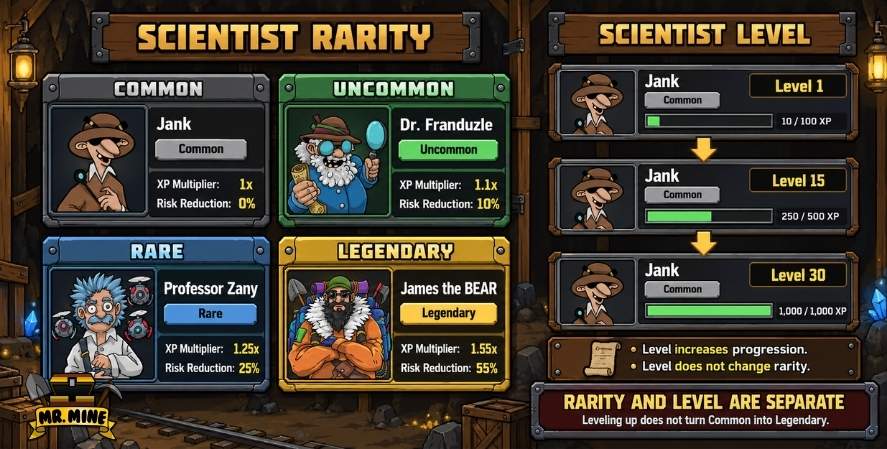
Rarity does not increase when a Scientist levels up.
A Common Scientist remains Common at level 1, level 30, or beyond.
Likewise, Scientist level does not directly reduce death chance.
Rarity and level affect different parts of the system.
What Does Scientist Level Do?
Scientist level affects excavation progression, including mission duration.
Current community documentation also records level-based scaling for certain rewards, including:
- Mineral piles
- Money bags
- Timelapses
- Super Miner Souls
Higher levels therefore remain useful even though they do not improve a Scientist’s rarity.
Reaching level 30 also completes the Unstoppable For Now… achievement.
Level 30 is another important point because Nightmare excavations can begin appearing among that Scientist’s mission options.
If you want to work toward Scientist and other progression milestones, see the Mr. Mine Achievements Guide.
How Scientist Death Chance Actually Works
It helps to separate four different ideas:
Mission difficulty provides the starting risk.
Scientist rarity applies a rarity-based reduction to that risk.
Scientist level does not directly lower the death chance.
Relics, such as the Book of Success, can further improve excavation success.
This means a level 50 Common Scientist does not receive the same rarity protection as a Legendary Scientist simply because it has more experience.
What Happens When a Scientist Dies?
The community Scientist reference reports that an excavation’s outcome is determined when the mission begins, although a doomed Scientist may appear to die at different points during the mission.
Scientists also have resurrection mechanics.
Current community documentation lists a small base chance of automatic resurrection, while Scythe-type relics can improve that chance. If the Scientist does not automatically return, the game can give you options to bury or revive them with Tickets.
The important strategy point is simpler:
A high-level Scientist represents time you can lose.
Before starting a dangerous excavation, compare the value of the reward with the value of keeping that Scientist.
Does Scientist Rarity Give Better Rewards?
Not automatically.
A Legendary Scientist does not guarantee better loot simply because it is Legendary.
Rarity mainly changes the Scientist’s own characteristics, such as:
- Failure/death reduction
- XP multiplier
- Death-related RNG rolls
The available excavation reward is a separate part of the mission.
Scientist level can also influence the amount of certain scalable rewards.
So instead of asking:
“Which Scientist gives the best loot?”
A more useful question is:
“Is this excavation reward worth risking this Scientist?”
How Do You Get Higher-Rarity Scientists?
You do not turn a Common Scientist into a Legendary Scientist simply by leveling it.
Instead, you obtain Scientists through the game’s Scientist reward systems.
Treasure Chests
After Scientists unlock, treasure chests can provide new Scientists while you have an open active slot.
Your first chest after reaching the Scientist stage is designed to help start the system.
Once all three Scientist slots are full, normal chest acquisition no longer gives you another active Scientist.
For more information about chest mechanics, see the Mr. Mine Treasure Chests Guide.
Excavations
Some excavation rewards can provide another Scientist.
These opportunities are relevant when you have an empty Scientist slot, but you still need to consider the mission’s risk.
Losing a developed Scientist while trying to find a replacement can be a poor trade.
Caves and Scientist Scrolls
Caves can provide Scientist scrolls.
These are particularly useful because they can be stored through the cave system.
If you use a Scientist scroll while all three active Scientist slots are filled, the reward can instead provide XP to one of your current Scientists.
That makes Scientist scrolls useful even after you reach the active roster limit.
What Happens When You Have Three Scientists?
Three is the active Scientist cap.
At that point, your focus starts shifting from simply finding Scientists to improving the roster you already have.
You might have:
- A high-level Common Scientist
- A developing Rare Scientist
- A new Legendary Scientist
There is no single rule that says the highest rarity should always replace everything else immediately.
Level, current excavation options, achievements, and the time already invested in each Scientist also matter.
Should You Replace a Common Scientist With a Rare or Legendary Scientist?
Usually, higher rarity offers better long-term potential.
However, replacing a developed Scientist immediately is not always the best short-term decision.
Before making a roster decision, consider:
- The current level of both Scientists.
- The rarity advantage of the new Scientist.
- Which excavation difficulties you normally run.
- Whether you are working toward level-based achievements.
- How quickly you can level the replacement.
- How much progress you would lose if the older Scientist disappears.
A new Rare or Legendary Scientist will usually become more attractive as you invest XP into it.
But a heavily leveled Common Scientist can still have immediate value while the replacement develops.
What Are Warped Scientists?
Warped Scientists belong to the later Core progression system.
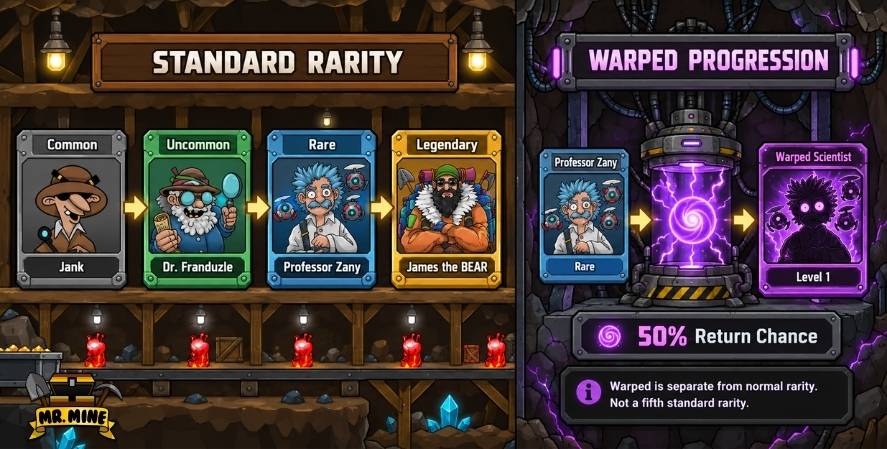
They should not be presented as a normal fifth rarity after Legendary.
The standard rarity ladder remains:
Common → Uncommon → Rare → Legendary
Warped Scientists are created through a separate transformation system after you gain access to the Core.
How to Get a Warped Scientist
The Core becomes available much later in progression, at 501 km.
To attempt a Warped Scientist transformation:
- Reach the Core.
- Use a Book of Secrets to change the Basic Core into its Warped state.
- Sacrifice a Scientist to the Warped Core.
- The Scientist sacrifice has a 50% return chance.
- If the Warped transformation succeeds, the returned Scientist begins at level 1.
That last point is important.
If you sacrifice a level 40 Scientist and the Warped transformation succeeds, you do not receive a level 40 Warped Scientist. The returned Scientist starts over at level 1.
For a full explanation of the feature, read the Introduction to the Core in Mr. Mine.
Can You Get a Divine Scientist?
No.
Mr. Mine has Divine Core mechanics for other items, but there is no Divine Scientist tier.
Using a Divine Core on a Scientist can still return a Warped Scientist rather than a Divine one.
Because the Scientist return chance is the same, using the Warped Core is normally the more efficient option if your goal is specifically to transform a Scientist.
Warped vs. Legendary Scientists
Legendary is a standard rarity.
Warped is a Core-based Scientist progression state.
That difference matters because a new player should not read the system as:
Common → Uncommon → Rare → Legendary → Warped
The first four belong to the normal rarity system. Warped progression comes later and follows different rules.
Community documentation also describes advanced Warped states such as Warped, Warped+, and Warped++.
Because these mechanics sit beyond the normal rarity table, they are best treated as their own progression system.
When comparing Mr. Mine Scientist Rarities, Legendary offers the strongest bonuses among the four standard tiers.
Which Scientist Rarity Is Best in Mr. Mine?
Legendary is the strongest standard Scientist rarity.
It has the best standard rarity modifier, highest XP multiplier, and most documented death-related RNG rolls.
However, the “best Scientist” in your current roster can depend on more than rarity.
Consider:
- Scientist level
- Excavation difficulty
- Available rewards
- Relics
- Achievement goals
- Current roster
- Access to Warped progression
A developed Rare Scientist can sometimes be more immediately useful than a brand-new Legendary.
Later, Warped Scientists add another layer beyond the four normal rarities.
How to Keep Rare and Legendary Scientists Alive
Avoid Bad Risk-to-Reward Trades
Do not choose a dangerous excavation simply because it is available.
If the reward does not meaningfully help your current progression, keeping the Scientist may be more valuable.
Protect High-Level Scientists
The higher the level, the more time you have invested.
A dangerous mission can erase that progression if the Scientist dies and you decide not to revive it.
Refresh Poor Excavation Choices
The game lets you refresh excavation choices with a Ticket.
If both choices put an important Scientist at unnecessary risk, refreshing can sometimes be more sensible than forcing a bad mission.
Use the Book of Success
The Book of Success is a Legendary relic that improves excavation success rates.
Normal, Warped, and Divine versions provide stronger effects, and current reference data places a cap on the total effect.
This makes the Book of Success especially useful when protecting valuable Scientists from riskier excavations.
Treat Nightmare Missions Carefully
Nightmare excavations can start with very high failure chances.
Rarity and relics can make them safer, but a Legendary Scientist is not automatically safe just because it has better defensive mechanics.
Check the displayed risk before committing a Scientist you do not want to lose.
Common Scientist Rarity Mistakes
Thinking Level Increases Rarity
It does not.
Common stays Common, Rare stays Rare, and Legendary stays Legendary regardless of level.
Thinking Level Reduces Death Chance
It does not directly do so.
Higher levels help with other parts of excavation progression, while rarity handles the Scientist’s built-in risk reduction.
Assuming Legendary Means Better Loot
Legendary makes the Scientist stronger.
It does not turn every excavation reward into a better reward.
Confusing Scientists With Super Miner Rarity
Scientists and Super Miners are separate systems.
Do not assume that rarity labels work identically across every feature in Mr. Mine.
Risking Valuable Scientists for Weak Rewards
A mission can be technically possible without being worthwhile.
Always compare the reward with the progress you could lose.
Sacrificing a High-Level Scientist Without Knowing About the Level Reset
A successful Warped Scientist transformation returns the Scientist at level 1.
Know that before sacrificing a Scientist that took a long time to develop.
Mr. Mine Scientist Rarities FAQ
What are the four Scientist rarities in Mr. Mine?
The four standard rarities are Common, Uncommon, Rare, and Legendary.
What is the rarest standard Scientist rarity?
Legendary is the highest standard rarity.
How many Scientists are in Mr. Mine?
Current official Mr. Mine material lists 17 standard Scientists.
That includes eight Common, four Uncommon, three Rare, and two Legendary Scientists.
How many Scientists can you have at once?
You can have up to three active Scientists.
Can Scientists die?
Yes.
Medium, Hard, and Nightmare excavations can carry a failure/death chance. Scientist rarity and excavation-supporting relics can reduce the risk, but dangerous missions can still kill valuable Scientists.
Does leveling a Scientist lower death chance?
No.
Scientist level and rarity are separate. Level does not directly reduce the chance of death.
Can a Common Scientist become Legendary by leveling?
No.
Leveling does not change rarity.
How do you get a Legendary Scientist?
Legendary Scientists come through normal Scientist acquisition systems such as chests, excavations, and caves. A lower-rarity Scientist does not become Legendary simply through leveling.
Who are the Legendary Scientists?
The two standard Legendary Scientists are Dr. Archibald and James The BEAR.
What does Scientist rarity affect?
Rarity affects a Scientist’s failure/death reduction, XP multiplier, and documented death-related RNG rolls.
Are Warped Scientists a fifth rarity?
Not in the same sense as Common, Uncommon, Rare, and Legendary.
Warped Scientists belong to a separate Core-based progression system.
What is the chance of getting a Warped Scientist from a sacrifice?
Current Core documentation gives Scientist sacrifices a 50% return chance.
A successful Warped transformation returns a level 1 Warped Scientist.
Are there Divine Scientists?
No.
A Divine Core does not create a Divine Scientist.
Is a Legendary Scientist worth keeping?
Usually, yes.
Legendary Scientists have the strongest bonuses among the four standard rarities, making them excellent long-term excavation characters.
Mr. Mine Scientist List by Standard Rarity
| Rarity | Scientists |
|---|---|
| Common | Jank, Mrs. Marge, Taylor, Ziggy, The Aussie, Lt. Ramirez, Layla, Dennis |
| Uncommon | Dallas, Ernie, Dr. Gilbert, Dr. Franduzle |
| Rare | Mr. Mustache, Mr. Mustachio, Professor Zany |
| Legendary | Dr. Archibald, James The BEAR |
Final Thoughts on Mr. Mine Scientist Rarities
The standard Mr. Mine Scientist Rarities system is easy to remember:
Common → Uncommon → Rare → Legendary
What matters more is understanding what rarity actually does.
Higher rarity gives Scientists better survival characteristics and faster XP growth. Level is separate: it affects excavation progression but does not directly lower death chance.
Mission difficulty adds another layer of risk. Easy missions start at 0% failure, while Nightmare missions can reach extremely dangerous levels.
Finally, Warped Scientists belong to a later progression system. Sacrificing a Scientist through the Warped Core can create a Warped Scientist, but the return chance is only 50%, and a successful result starts again at level 1.
Once you understand those differences, Scientist decisions become much easier. Instead of simply chasing the rarest character, you can balance rarity, level, excavation risk, rewards, relics, and Warped progression to build a stronger excavation team.
Next, learn more about Scientists and excavation missions in Mr. Mine to plan safer missions and get more value from every Scientist you keep.

One thought on “Mr. Mine Scientist Rarities: Levels & Warped Scientists Explained”